
Cambridge Economics is one of the most rewarding yet challenging subjects in the O Level and AS & A Level curriculum. Many students believe that success comes from memorising definitions, diagrams, and textbook explanations. In reality, students who consistently achieve an A* develop a much deeper understanding of economic concepts and know how to apply them to unfamiliar situations.
The Cambridge examination does not simply test what you know—it tests how well you think like an economist. Whether you are preparing for Cambridge O Level, IGCSE, AS Level, or A Level Economics, this guide will show you the habits, strategies, and exam techniques that separate top-performing students from the rest.
Understand What Cambridge Examiners Want
One of the biggest mistakes students make is preparing for Economics like a memory-based subject. Cambridge examiners are looking for students who can:
- Explain economic concepts accurately.
- Apply theories to real-world situations.
- Analyse causes and consequences.
- Evaluate different viewpoints.
- Support arguments using appropriate economic terminology.
In higher-mark questions, simply knowing the theory is never enough. You must demonstrate economic reasoning throughout your answer.
For example, instead of writing:
Inflation causes prices to rise.
A high-scoring student explains:
Inflation reduces the purchasing power of money. If wages do not increase at the same rate, consumers experience a fall in real income, leading to reduced consumption of non-essential goods.
Notice the difference. The second response explains why and how, which is exactly what Cambridge rewards.
Master the Syllabus Before the Textbook
Many students spend months reading textbooks without fully understanding what the syllabus actually requires.
The Cambridge syllabus is your roadmap.
For every topic, ask yourself:
- Can I define this concept?
- Can I explain it?
- Can I draw the required diagrams?
- Can I apply it to real-life examples?
- Can I evaluate different outcomes?
If you cannot answer “yes” to all five questions, your revision is incomplete.
Build Strong Economic Foundations
Economics is like a chain. Every topic connects to another.
For example:
Scarcity → Choice → Opportunity Cost → Demand → Supply → Markets → Government Intervention → Economic Growth → Inflation → Unemployment.
If your understanding of early topics is weak, later chapters become much harder.
Spend extra time mastering:
- Basic economic problem
- Opportunity cost
- Demand and supply
- Elasticity
- Market failure
- Government policies
- Macroeconomic objectives
- International trade
Students who rush through these chapters often struggle in examinations.
Learn Concepts Instead of Memorising Notes
Memorisation has limits.
Cambridge frequently introduces unfamiliar scenarios.
If you only memorise model answers, you may struggle when the question changes.
Instead, understand:
- Why demand shifts.
- Why supply changes.
- Why inflation occurs.
- Why unemployment rises.
- Why exchange rates fluctuate.
Once you understand the reasoning, you can answer almost any application question.
Practise Drawing Diagrams Perfectly
Diagrams are an essential part of Economics.
Common diagrams include:
- Demand and Supply
- Price Elasticity
- Tax and Subsidy
- Maximum and Minimum Price
- Cost and Revenue Curves
- Production Possibility Curve
- AD-AS Model (A Level)
- Labour Market
- Exchange Rate
A perfect diagram should include:
- Clear labels
- Correct axes
- Accurate shifts
- New equilibrium
- Proper arrows
- Relevant explanation
Remember that a diagram alone earns very few marks. Always explain what it shows.
Develop the Habit of Explaining Every Point
A common weakness among average students is stopping after making one statement.
For example:
Government increases taxes.
A stronger answer would be:
Government increases indirect taxes, raising production costs for firms. Higher costs shift the supply curve to the left, reducing output while increasing prices. Consumers therefore purchase fewer goods, leading to lower demand in the market.
Notice how every statement logically leads to the next.
This chain of reasoning is what Cambridge examiners reward.
Use Real-World Examples
Economics exists everywhere.
The best students regularly connect theory to current events.
Examples include:
- Rising fuel prices
- Exchange rate fluctuations
- Interest rate changes
- Inflation trends
- International trade disputes
- Government subsidies
- Environmental policies
Using relevant examples demonstrates genuine understanding and strengthens evaluation.
Practise Past Papers Regularly
No amount of reading can replace past paper practice.
Past papers help you:
- Understand question styles.
- Improve time management.
- Recognise common themes.
- Learn examiner expectations.
- Reduce exam anxiety.
Instead of solving papers randomly:
- Complete one topic.
- Attempt topic-based questions.
- Review mistakes.
- Repeat until confident.
- Move to full-length papers.
Quality practice is far more valuable than quantity.
Study Examiner Reports
One of the most underused Cambridge resources is the examiner report.
These reports explain:
- Common mistakes.
- Frequently misunderstood concepts.
- Why students lose marks.
- Characteristics of high-scoring answers.
Reading examiner reports gives you insight into the examiner’s thinking—something textbooks cannot provide.
Master Command Words
Many students lose marks because they answer the wrong question.
Know the difference between command words.
Define
Give the precise meaning.
Identify
State the correct answer without explanation.
Explain
Describe why something happens.
Analyse
Show relationships and chains of reasoning.
Evaluate
Discuss advantages, disadvantages, limitations, and reach a justified conclusion.
Evaluation is particularly important in higher-level questions and often distinguishes A* candidates.
Write Structured Answers
Avoid writing everything you know.
Instead, organise your answers logically.
A useful structure is:
- Introduce the point.
- Explain the theory.
- Apply it to the question.
- Analyse the consequences.
- Evaluate where appropriate.
Well-structured answers are easier for examiners to follow and often score higher.
Improve Time Management
Many capable students fail to complete the examination.
A few tips include:
- Do not spend too long on one question.
- Leave difficult questions and return later.
- Allocate time according to marks.
- Keep five to ten minutes for checking.
Regular timed practice develops exam confidence.
Expand Your Economic Vocabulary
Strong answers use precise terminology.
Instead of saying:
- Prices go up
Write:
- The price level increases.
Instead of:
- People buy less
Write:
- Consumer demand contracts.
Instead of:
- Businesses make more money
Write:
- Firms experience increased profitability.
Using accurate economic language demonstrates deeper understanding.
Learn from Your Mistakes
Simply completing past papers is not enough.
Create an error notebook.
Record:
- Questions answered incorrectly.
- Missing diagrams.
- Weak explanations.
- Incorrect terminology.
- Evaluation points you forgot.
Review this notebook every week.
Avoid repeating the same mistakes.
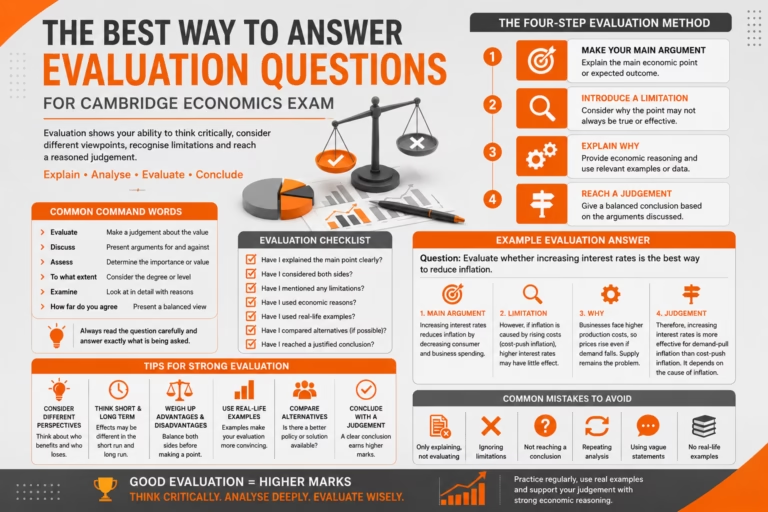
Never Ignore Evaluation
For many students aiming for an A*, evaluation is the difference between an A and an A*.
Evaluation means recognising that economic decisions have different outcomes depending on circumstances.
For example:
Instead of writing:
Lower interest rates increase spending.
A stronger evaluation is:
Lower interest rates may increase spending if consumers and businesses remain confident. However, during periods of economic uncertainty, households may prefer to save rather than spend, limiting the effectiveness of monetary policy.
This balanced approach demonstrates higher-order thinking.
Revise Consistently
Avoid last-minute cramming.
Economics requires repeated exposure to concepts.
An effective revision schedule includes:
- Daily review of previous topics.
- Weekly diagram practice.
- Weekly essay writing.
- Regular MCQ practice.
- One timed past paper every week during exam season.
Consistency always beats intensity.
Stay Curious About the World
Economics is happening around you every day.
Read business news, follow economic developments, and ask questions such as:
- Why did fuel prices rise?
- Why is inflation increasing?
- Why is unemployment falling?
- Why do exchange rates change?
- Why do governments introduce taxes or subsidies?
Students who connect classroom learning with real-world events naturally develop stronger analytical skills.
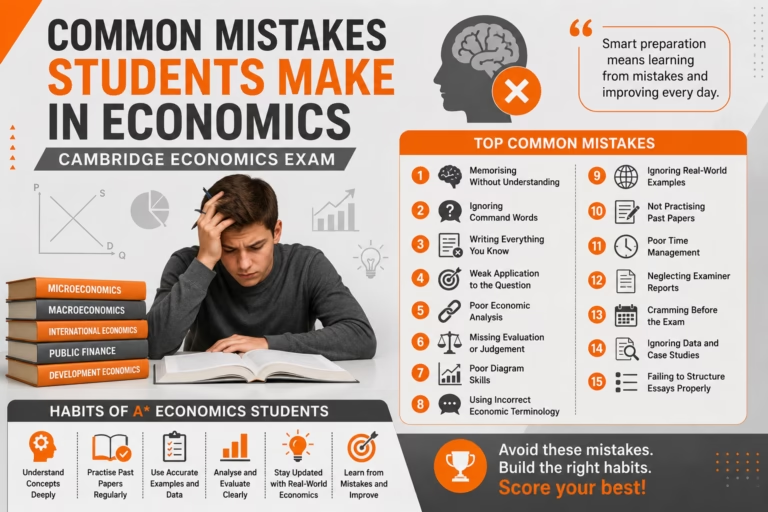
Common Mistakes That Prevent an A*
Many students miss top grades because they:
- Memorise without understanding.
- Ignore diagrams.
- Skip evaluation.
- Misread command words.
- Fail to apply theory to the question.
- Write vague explanations.
- Depend entirely on model answers.
- Neglect examiner reports.
- Practise too few past papers.
- Revise only before exams.
Avoiding these mistakes can significantly improve your final grade.
Final Thoughts
Achieving an A* in Cambridge Economics is not about being naturally gifted or studying endless hours. It is about developing the habits of an economist: understanding concepts deeply, applying theory to real-world situations, analysing relationships, evaluating different perspectives, and communicating ideas with clarity.
The most successful students focus on consistent practice, careful review of examiner expectations, and thoughtful application rather than rote memorisation. Every diagram you perfect, every past paper you analyse, and every mistake you learn from brings you one step closer to the highest grade.
Remember, Economics is far more than an academic subject—it is a way of thinking about the choices people, businesses, and governments make every day. Master that way of thinking, and an A* becomes an achievable goal rather than an impossible dream.