
Achieving a high grade in Cambridge Economics requires much more than memorising definitions and reading textbooks. Every year, thousands of capable students lose valuable marks—not because they lack knowledge, but because they make avoidable mistakes during revision and in the examination hall.
Cambridge examiners consistently emphasize that successful candidates demonstrate clear understanding, logical analysis, accurate application, and balanced evaluation. Students who fail to meet these expectations often miss out on an A or A* despite studying hard.
Whether you are preparing for Cambridge O Level, IGCSE, AS Level, or A Level Economics, understanding these common mistakes can help you avoid them and significantly improve your exam performance.
Mistake 1: Memorising Without Understanding
One of the biggest mistakes students make is treating Economics as a memorisation subject.
Many students can recite definitions perfectly but struggle when faced with application or case-study questions.
For example, a student may memorise:
Inflation is a sustained increase in the general price level.
However, when asked:
Explain how rising oil prices can cause inflation.
They fail to explain the chain of economic reasoning.
How to Avoid It
Instead of memorising facts, ask yourself:
- Why does this happen?
- What happens next?
- Who is affected?
- What are the consequences?
- Are there any exceptions?
Cambridge rewards understanding far more than memorisation.
Mistake 2: Ignoring the Command Words
Every Economics question contains a command word that tells you exactly what the examiner expects.
Students often lose marks because they answer a different question.
Common command words include:
- Define
- Identify
- Describe
- Explain
- Analyse
- Discuss
- Evaluate
- Compare
Example
If the question asks:
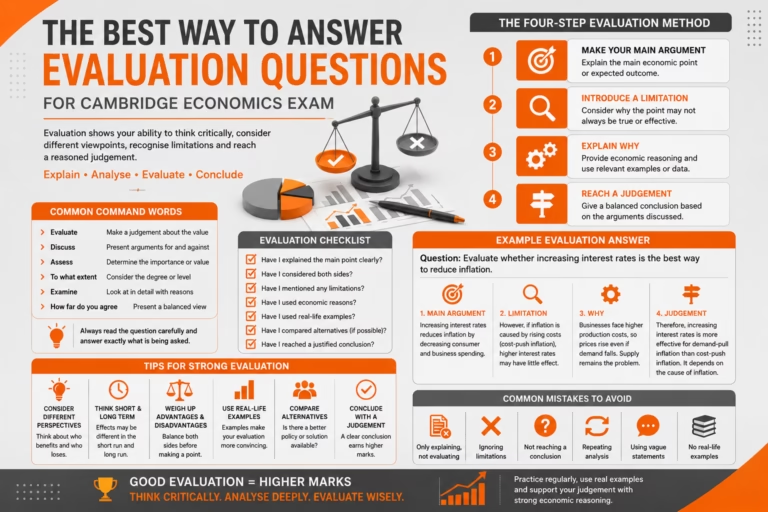
Evaluate the effectiveness of raising interest rates to control inflation.
Many students simply explain how interest rates work.
They forget to evaluate.
Evaluation requires discussing:
- Advantages
- Disadvantages
- Limitations
- Alternative viewpoints
- A justified conclusion
Without evaluation, students cannot earn full marks.
Mistake 3: Writing Everything You Know
Some students believe longer answers automatically score higher.
They fill pages with unrelated theory.
Cambridge examiners award marks for relevant information.
If the question is about unemployment, avoid discussing inflation unless it directly supports your argument.
Better Strategy
Focus on:
- Answering the exact question.
- Using relevant theory.
- Applying it to the context.
- Keeping explanations clear and logical.
Quality always beats quantity.
Mistake 4: Weak Application
Application is one of the most important assessment objectives.
Students often write textbook answers without referring to the scenario in the question.
For example, if a case study discusses tourism, your answer should refer specifically to the tourism industry rather than giving a generic explanation.
High-Scoring Answers
Always connect theory to the information provided.
Use:
- Industry names
- Countries
- Government policies
- Businesses
- Consumer behaviour
Application shows that you understand Economics beyond memorised notes.
Mistake 5: Forgetting Economic Analysis
Analysis is the ability to explain cause-and-effect relationships.
Many students make one statement and stop.
For example:
Higher taxes reduce demand.
This explanation is incomplete.
A stronger response would be:
Higher indirect taxes increase production costs, causing firms to raise prices. Higher prices reduce consumer demand, leading to lower sales and potentially lower output and employment.
Each point should logically lead to the next.
This chain of reasoning earns higher marks.
Mistake 6: Missing Evaluation
Evaluation often separates A-grade students from A* candidates.
Students frequently explain both sides but never reach a judgement.
For example:
Interest rates may reduce inflation by lowering consumer spending. However, if inflation is caused by rising production costs rather than excessive demand, higher interest rates may have only a limited impact.
A strong answer finishes with a reasoned conclusion.
Example:
Therefore, raising interest rates is generally more effective against demand-pull inflation than cost-push inflation.
This final judgement demonstrates higher-level thinking.
Mistake 7: Poor Diagram Skills
Economics diagrams are powerful tools, but many students lose marks because they:
- Forget labels.
- Miss axis titles.
- Draw incorrect curves.
- Fail to explain diagrams.
- Use diagrams that are not relevant.
Remember:
A diagram alone rarely earns many marks.
Always explain:
- What shifted.
- Why it shifted.
- What happened to equilibrium.
- The economic consequences.
Mistake 8: Using Incorrect Economic Terminology
Economics has precise language.
Instead of writing:
Prices go up.
Write:
The general price level increases.
Instead of:
People buy less.
Write:
Consumer demand contracts.
Instead of:
Businesses lose money.
Write:
Firms experience lower profitability.
Using proper terminology demonstrates stronger economic understanding.
Mistake 9: Ignoring Real-World Examples
Economics is based on real economies.
Students who use relevant examples often produce stronger answers.
Examples include:
- Rising global oil prices.
- Inflation after the COVID-19 pandemic.
- Government subsidies.
- Exchange rate fluctuations.
- International trade disputes.
- Environmental taxes.
Real-world examples strengthen both application and evaluation.
Mistake 10: Not Practising Past Papers
Reading notes is not enough.
Past papers teach students:
- Question patterns.
- Examiner expectations.
- Time management.
- Common mistakes.
Students aiming for an A* should complete a wide range of past papers under timed conditions.
After each paper:
- Check the marking scheme.
- Read examiner comments.
- Identify weak topics.
- Correct mistakes.
Improvement comes from reflection, not repetition alone.
Mistake 11: Poor Time Management
Many students spend too long on difficult questions.
As a result, they rush later questions and lose easy marks.
A good strategy is:
- Read the paper carefully.
- Allocate time according to marks.
- Leave difficult questions temporarily.
- Return if time allows.
- Keep the final five to ten minutes for checking.
Practising timed papers helps build confidence and speed.
Mistake 12: Neglecting Examiner Reports
Examiner reports are among the most valuable Cambridge resources.
They explain:
- Frequent misconceptions.
- Why students lose marks.
- Characteristics of excellent answers.
- Common weaknesses across examination sessions.
Students who regularly read examiner reports gain insight into exactly what Cambridge expects.
Mistake 13: Cramming Before the Exam
Economics cannot be mastered overnight.
Students who leave revision until the final week often forget key concepts under pressure.
A better approach is:
- Review topics weekly.
- Practise diagrams regularly.
- Solve past paper questions every week.
- Revise mistakes repeatedly.
Consistent revision produces stronger long-term understanding.
Mistake 14: Ignoring Data and Case Studies
Many Cambridge questions include tables, graphs, or case studies.
Students sometimes begin writing before carefully reading the information provided.
Instead:
- Highlight important statistics.
- Identify economic trends.
- Refer directly to the data.
- Use figures to support your analysis.
Integrating evidence from the case study demonstrates excellent application skills.
Mistake 15: Failing to Structure Essays
A well-structured answer is easier for the examiner to follow.
A useful structure is:
- Introduce the economic issue.
- Explain the relevant theory.
- Apply it to the context.
- Analyse the effects.
- Evaluate different perspectives.
- Reach a justified conclusion.
Avoid jumping randomly between ideas.
Logical organisation improves clarity and often leads to higher marks.
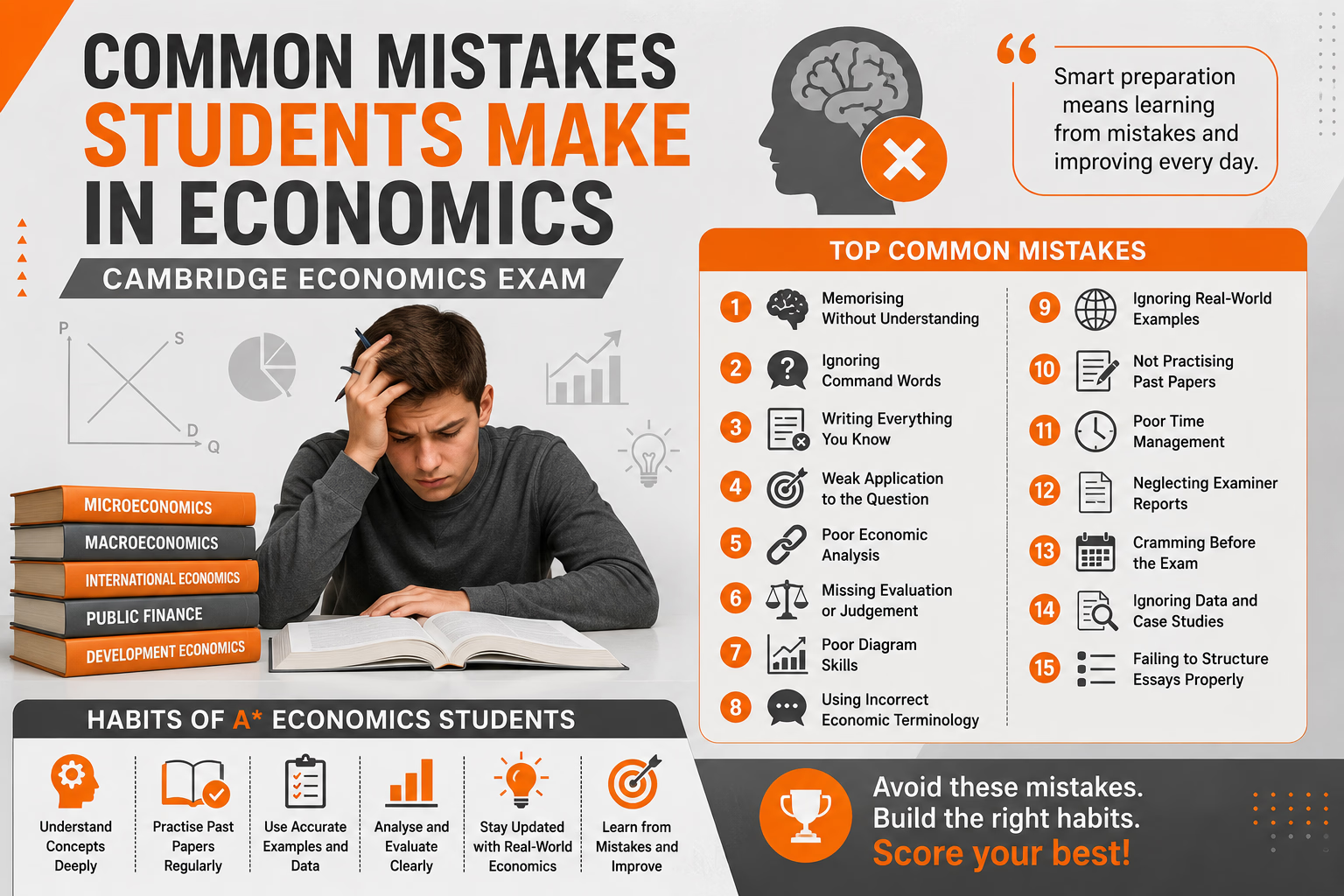
Habits of A* Economics Students
Students who consistently achieve top grades usually:
- Understand concepts instead of memorising them.
- Practise past papers regularly.
- Read examiner reports.
- Use accurate economic terminology.
- Draw and explain diagrams correctly.
- Apply theory to real-life situations.
- Include balanced evaluation.
- Manage exam time effectively.
- Learn from mistakes instead of repeating them.
- Stay updated with current economic events.
These habits gradually build the analytical thinking that Cambridge examinations reward.
Final Thoughts
Most students who fall short of an A* in Cambridge Economics do not fail because the subject is too difficult—they lose marks through avoidable mistakes. Memorising without understanding, ignoring command words, weak application, poor analysis, missing evaluation, and ineffective exam technique are all common reasons why capable students underperform.
The good news is that these mistakes can be corrected. By focusing on conceptual understanding, practising past papers, using precise economic terminology, applying theory to real-world examples, and structuring answers clearly, you can significantly improve your performance.
Remember, Cambridge Economics is not about writing the longest answer—it is about writing the most relevant, analytical, and well-supported answer. Develop the habits of an economist, learn from every mistake, and approach each question with confidence. With consistent effort and the right strategy, achieving an A* is an attainable goal.