
One of the biggest differences between an average Economics student and an A* candidate is the ability to write strong evaluation. While many students can explain economic concepts and analyse cause-and-effect relationships, they often struggle when asked to evaluate. As a result, they lose valuable marks in the highest-mark questions.
In Cambridge O Level, IGCSE, AS Level, and A Level Economics, evaluation is one of the key assessment skills. It demonstrates that you can think critically, consider different perspectives, recognise limitations, and make reasoned judgments based on economic evidence.
If you’re aiming for top grades, mastering evaluation is essential. This guide explains what evaluation is, why it matters, and how to answer evaluation questions effectively in the Cambridge Economics exam.
What Is Evaluation in Economics?
Evaluation means judging how effective, important, beneficial, or realistic an economic argument, policy, or decision is.
Rather than simply explaining what happens, evaluation asks you to consider:
- Will it always work?
- What are the advantages?
- What are the disadvantages?
- Under what conditions will it be effective?
- Who benefits and who loses?
- Are there alternative solutions?
- Which option is better overall?
In simple terms, evaluation is about thinking beyond the theory.
Why Does Cambridge Award Marks for Evaluation?
Economics is rarely black and white.
Most economic policies have both positive and negative consequences.
For example:
Increasing taxes may reduce inflation by lowering consumer spending, but it may also discourage business investment and slow economic growth.
There is no single perfect answer.
Cambridge rewards students who recognise this complexity and provide balanced, evidence-based judgments.
Understanding Command Words
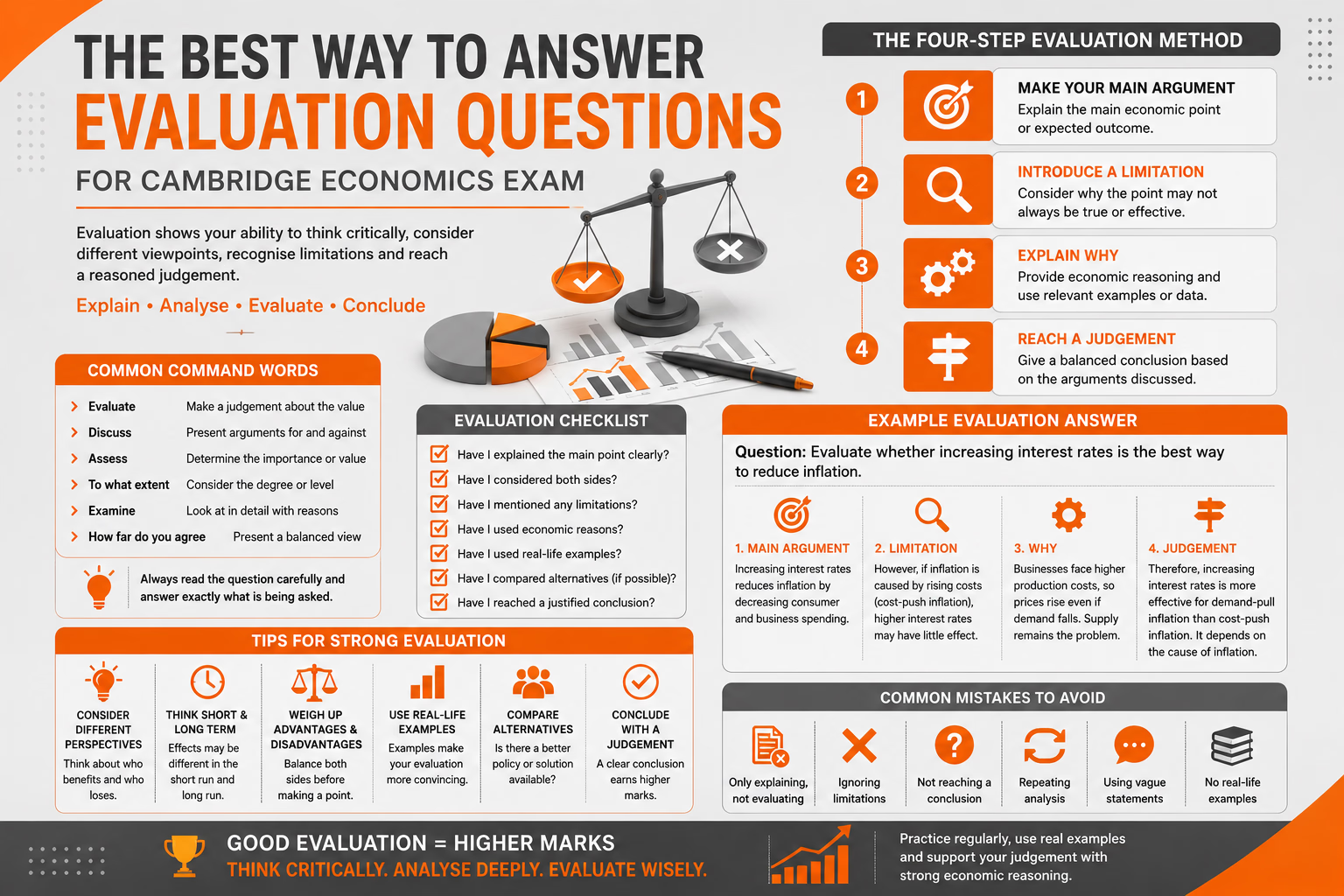
Evaluation is commonly tested using command words such as:
- Evaluate
- Discuss
- Assess
- To what extent
- Consider
- Examine
- How far do you agree?
Whenever you see these words, remember that explanation alone is not enough.
You must reach a reasoned conclusion.
The Difference Between Analysis and Evaluation
Many students confuse analysis with evaluation.
Analysis
Analysis explains how and why something happens.
Example:
Lower interest rates encourage borrowing, increasing consumer spending and investment. Higher aggregate demand may increase economic growth and employment.
Evaluation
Evaluation judges whether this outcome is likely and under what circumstances.
Example:
However, if consumer confidence is low during an economic recession, households may choose to save rather than spend despite lower interest rates. Therefore, monetary policy may have only a limited effect in these circumstances.
Notice how evaluation introduces limitations and conditions.
The Four-Step Evaluation Method
One of the easiest ways to write high-quality evaluation is to follow a structured approach.
Step 1: Make Your Main Argument
Begin by explaining the expected economic outcome.
Example:
Increasing indirect taxes is likely to reduce demand for harmful products.
Step 2: Introduce a Limitation
Now explain why the result may not always occur.
Useful phrases include:
- However…
- On the other hand…
- This depends on…
- Nevertheless…
- In contrast…
- Although…
Example:
However, demand for cigarettes is relatively inelastic, meaning consumers may continue buying them despite higher prices.
Step 3: Explain Why
Support your limitation with economic reasoning.
Example:
Because smokers are addicted, higher prices may reduce consumption only slightly.
The government may therefore collect more tax revenue without achieving a significant reduction in smoking.
Step 4: Reach a Judgment
Always finish with a justified conclusion.
Example:
Therefore, increasing indirect taxes is more effective at raising government revenue than reducing consumption of addictive products.
This final judgement is often what separates an A* answer from an average one.
Use the “It Depends” Approach
Many evaluation questions depend on economic circumstances.
Ask yourself:
“It depends on what?”
Possible factors include:
- Consumer confidence
- Elasticity of demand
- Availability of substitutes
- Government policy
- Business expectations
- Economic growth
- Inflation rate
- Exchange rates
- Time period
- Level of unemployment
Considering these factors strengthens your evaluation.
Evaluate Both Short-Term and Long-Term Effects
Many policies produce different results over time.
Example:
Higher interest rates may reduce inflation quickly by lowering demand.
However, if interest rates remain high for an extended period, investment may fall, reducing long-term economic growth.
Recognising different time horizons demonstrates deeper economic understanding.
Consider Different Stakeholders
Economic decisions rarely affect everyone equally.
Ask yourself:
Who benefits?
Who loses?
For example, rising inflation may:
Benefit:
- Borrowers
- Businesses selling essential goods
Harm:
- Pensioners
- Savers
- Low-income households
Evaluating multiple perspectives produces stronger answers.
Compare Alternative Policies
Evaluation becomes stronger when you compare different approaches.
Example:
Instead of relying solely on higher interest rates, governments could also reduce public spending or implement supply-side policies to increase productivity.
Comparing alternatives demonstrates broader economic understanding.
Support Evaluation with Real-Life Examples
Cambridge values practical application.
Examples include:
- Rising global oil prices causing cost-push inflation.
- Government subsidies encouraging renewable energy.
- Higher interest rates reducing housing demand.
- Exchange rate depreciation increasing import prices.
Real-world examples make evaluation more convincing.
Common Evaluation Phrases
Using appropriate language helps communicate balanced judgment.
Useful expressions include:
- This depends on…
- In the short run…
- In the long run…
- To some extent…
- However…
- Nevertheless…
- Although…
- On balance…
- Overall…
- Therefore…
These phrases naturally guide the examiner through your reasoning.
Example Evaluation Question
Question:
Evaluate whether increasing the minimum wage always reduces poverty.
Weak Answer
Higher minimum wages increase workers’ incomes and reduce poverty.
This response explains the theory but provides no evaluation.
Strong Answer
Increasing the minimum wage can reduce poverty by increasing workers’ incomes and improving living standards.
However, if businesses cannot afford higher labour costs, they may reduce employment or hire fewer workers. As a result, some individuals could lose their jobs, offsetting the benefits of higher wages.
The effectiveness of a minimum wage therefore depends on labour market conditions, business profitability, and the size of the wage increase.
Overall, moderate increases in the minimum wage are generally more effective than large increases because they improve incomes while reducing the risk of unemployment.
Notice how the answer:
- Explains
- Introduces limitations
- Considers conditions
- Reaches a balanced conclusion
This is exactly what Cambridge examiners look for.
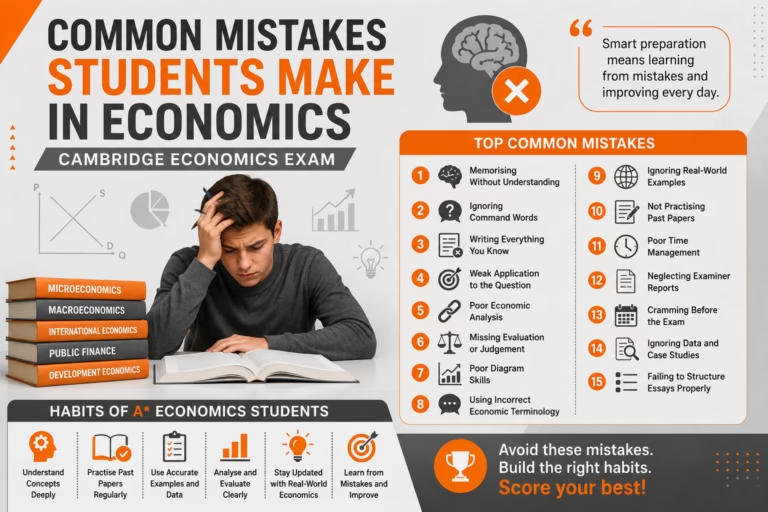
Common Evaluation Mistakes
Students often lose marks because they:
- Only explain advantages.
- Forget disadvantages.
- Never reach a conclusion.
- Repeat analysis instead of evaluating.
- Write vague statements without economic reasoning.
- Ignore the specific context of the question.
- Fail to support arguments with examples.
Recognising these mistakes is the first step toward improving your answers.
Practical Tips for A* Evaluation
To strengthen your evaluation:
- Always ask, “Will this always happen?”
- Consider both positive and negative outcomes.
- Think about different groups affected.
- Discuss short-term and long-term effects.
- Compare alternative policies where appropriate.
- Use economic terminology accurately.
- Support points with real-life examples.
- Finish with a clear, justified conclusion.
These habits consistently improve the quality of higher-mark answers.
How Examiners Award Evaluation Marks
Cambridge examiners reward students who:
- Present balanced arguments.
- Recognise uncertainty.
- Apply theory to context.
- Explain limitations.
- Make justified judgments.
- Use clear economic reasoning.
- Support conclusions with evidence.
Simply writing “however” is not enough—the evaluation must add meaningful insight.
Final Thoughts
Evaluation is one of the most important skills in Cambridge Economics because it shows that you can think critically rather than simply recall information. The strongest students recognise that economic problems rarely have perfect solutions. Instead, they weigh advantages against disadvantages, consider different viewpoints, analyse conditions, and reach well-supported conclusions.
Whenever you answer an evaluation question, remember this simple formula:
Explain → Introduce a limitation → Justify it → Reach a balanced conclusion.
By practising this structure regularly, using real-world examples, and applying economic reasoning throughout your answers, you’ll become more confident in tackling high-mark questions. Mastering evaluation not only improves your exam technique but also gives you the analytical skills needed to achieve an A* in Cambridge Economics.